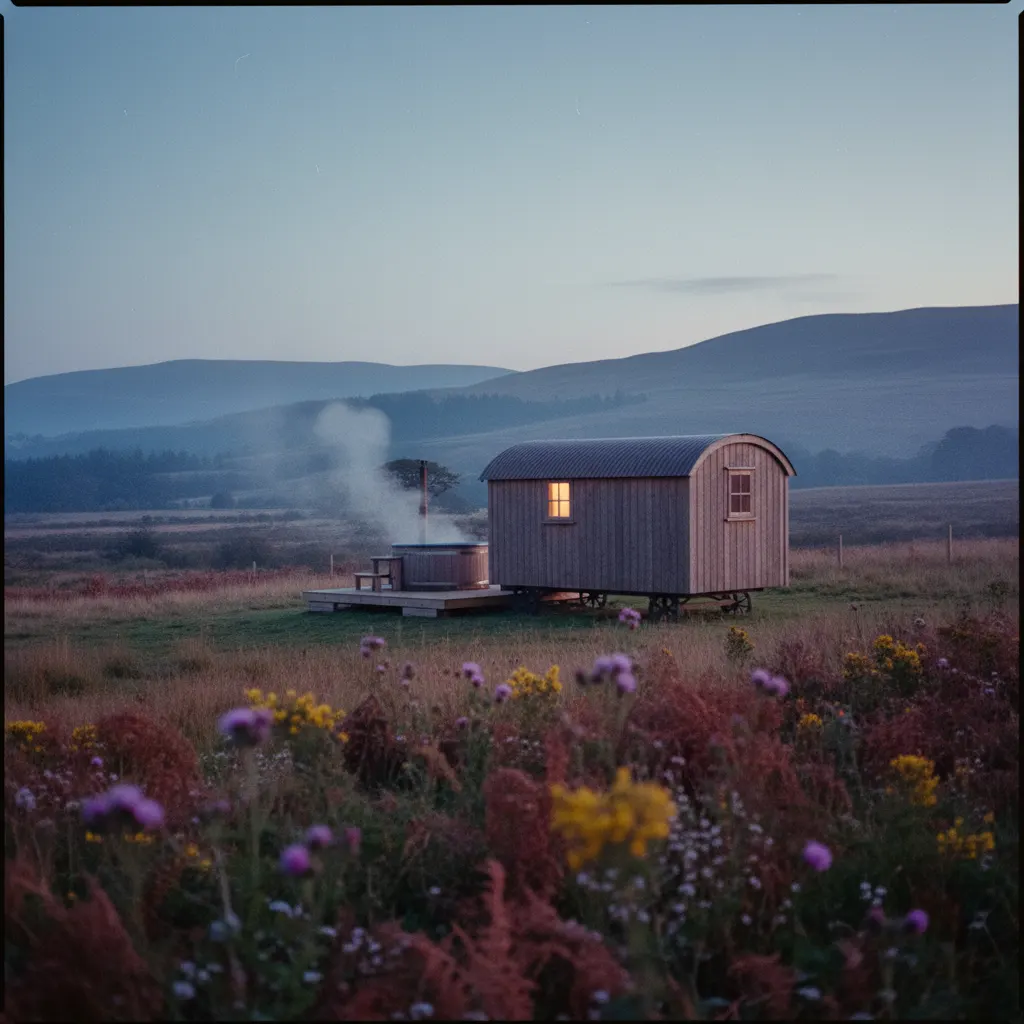
HAND-PICKED · WOOD-BURNER ON WHEELS
Small hut, wood-burner, private tub.
Shepherd’s huts in the UK
Snug timber shepherd’s huts on cast-iron wheels — a wood-burner, a proper bed and, on the best of them, a private hot tub steaming out on the deck. Small, simple, about as cosy as a stay gets.
The register
Shepherd’s huts by region
Twelve regions, every page walked before it earns a listing.


Small on purpose
What a shepherd’s hut actually is
A shepherd’s hut was built to follow the flock. The original huts were pulled out to the fields at lambing time on their cast-iron wheels, with a small stove to keep the shepherd warm through the cold nights, and towed back in again once the lambs were strong enough to manage without watching over. That history is why the shape has barely changed: one room, a curved or gabled roof, a stable-style door at one end and a window at the other, small enough to fit down a farm track and light enough to move by hand or tractor. Holiday shepherd’s huts keep the proportions almost exactly, right down to the wheels, which are usually still there even though the hut has not moved in years. That is the whole point of them — this is not a lodge with the volume turned down, it is a different kind of building with its own logic and its own limits.
Inside, everything earns its place. A proper bed, usually a double, sits at one end; a wood-burner sits near the door, where the flue can vent straight up and out; the rest is a bench, a rail, a shelf, built in rather than added on, because there is rarely a spare wall to stand loose furniture against. Done well, that is what keeps a shepherd’s hut snug rather than cramped — high ceilings at the ridge, a big window that pulls in more light than the footprint suggests, enough room to sit either side of the stove with a book and a drink. Done badly, it is a shed with a bed in it. We check for the difference before a hut goes on this list at all: window size, headroom over the bed, and whether the stove is a proper multi-fuel burner or a token electric heater standing in for one. At the luxury glamping end, a luxury shepherds hut retreat in the countryside is about as snug as it gets, and many are dog friendly, so the whole household comes along; a shepherd hut like this suits a couple after a quiet retreat rather than a crowd.
The big search
A shepherd’s hut with a hot tub
Search for a shepherds hut with hot tub and you will find most of the traffic this feature sees, and for good reason — a wood-burner inside and a hot tub a few steps outside is close to the ideal small-scale break. The catch is that the claim gets used loosely across the wider market: with a hot tub can mean anything from a private hot tub on your own deck to a shared spa down at reception. On some sites the tub is genuinely private, built onto decking that belongs to the hut itself; on others it is shared across a cluster of huts, or sat on open grass between two units with no screening at all. We check both things before a hut earns a place here: that the tub is a private hot tub belonging to your hut alone, and that there is some kind of fence, planting or angle that stops the next hut looking straight into it.
After privacy, the details that decide whether a soak is a pleasure or a faff are practical rather than glamorous. Ask, or check the listing, how long the tub takes to heat from cold if you are arriving mid-afternoon — some hosts fire it up before you get there, others leave it to you, and a two-hour wait is a long time to stand around on a wet evening. Look at the distance from hut door to tub, since a proper path matters more in January than in July, and check whether there is anywhere covered to leave a towel and a robe. It is also worth knowing whether the tub is wood-fired or electric — a wood-fired tub takes longer to come up to temperature but costs nothing to run, while an electric one heats faster but can push the price up if the provider adds it as a separate charge. A shepherd’s hut with a hot tub done right is one of the best small breaks going; done as an afterthought, it is a lukewarm tub on a patch of mud.
Where to look
Best regions for a shepherd’s hut holiday
Shepherd’s hut holidays cluster wherever a working farm is willing to give over a corner field, which means the good ones tend to be scattered rather than resorted-up in one spot. Shepherd’s huts in Cornwall usually come with a coast path or a cove within walking distance, and book hardest over the summer months. The Lake District huts sit in some of the most dramatic settings on this list — a hut on a fellside with the stove going and rain on the roof is most people’s idea of the whole point of the trip — and, like everything in the Lakes, they go early.
Yorkshire huts, particularly through the Dales, run at a noticeably gentler price for a very similar view, and Wales covers everything from a hut above a Pembrokeshire beach to one tucked into a fold of the Brecon Beacons. If you are simply typing shepherds huts near me into a search bar, start with whichever of these four regions is the shortest drive — a hut two hours away that you reach before dark on a Friday beats one further off that leaves you lighting the stove for the first time at eleven at night.
Who it suits
Who a shepherd’s hut suits, and who should size up
A shepherd’s hut suits a couple better than almost anything else we list. There is one proper bed, one stove, one door — nothing to divide a group around, and nowhere to be except next to each other. It also suits a first-time glamper who wants off-grid without committing to a tent: the compost loo and the lack of mains power give you the outdoorsy end of camping, but you still get a locked door, a real mattress and a roof that does not leak in the night. For anyone chasing that particular kind of quiet — no television, patchy signal, a stove that needs feeding every couple of hours — a hut is close to the purest version of it on this site.
Families and larger groups should generally look elsewhere. Most huts sleep two, occasionally two adults and a small child on a fold-out, and a wet weekend with nowhere to spread out gets old fast for anyone under ten. A glamping pod or a full glamping site with separate sleeping and living space handles a family far better, and if the trip is specifically about romance rather than roughing it, our romantic getaways page lists the huts alongside cabins and cottages built for exactly that. A shepherd’s hut is not a smaller lodge — it is a different kind of holiday, and it is worth being honest with yourself about which one you actually want before you book.
The practical reality
Off-grid living, compost loos and what to pack
Off-grid is the word that comes up most in shepherd’s hut listings, and it means different things at different sites, so it is worth checking rather than assuming. Some huts run on solar with a battery bank and enough power for lights and a phone charger, nothing more; others sit close enough to the farmhouse to be wired to the mains and run a kettle and a fridge without a second thought. The loo follows the same split — a compost loo in the hut, or a short walk away, is standard at the more remote sites, while huts closer to a main building often share a proper bathroom in a converted outbuilding nearby. It is also worth asking about the track in: plenty of huts sit at the end of an unmarked farm lane that satnav places roughly rather than exactly, and one that is fine in a normal car in August can be a different proposition after a week of rain.
Heating and insulation matter here more than almost anywhere else we list, because a shepherd’s hut has a lot of external wall for its size. A well-built hut with proper insulation and a multi-fuel stove is genuinely warm through the cold months — arguably cosier than a draughty cottage, since the whole room heats fast around one small stove going hard. A poorly insulated one is a different experience entirely, and no amount of firewood fixes a thin floor and a single-glazed window. Pack for the season rather than the postcode: thick socks and a hot water bottle even in late spring, wellies if the field has had any rain at all, and firelighters and matches if the host does not supply them, since starting a stove from cold at nine at night is not the moment to discover you have neither.
What you actually get
Inside a shepherd hut: deck, hot tub and small comforts
A modern shepherd hut holiday is more comfortable than the rustic charm of the outside suggests. The better boutique huts pack a lot into the length: a log burner, a compact kitchenette with a proper hob and fridge, and increasingly an en-suite shower and loo rather than a walk across a field. Out front, a private deck is where the hut earns its keep — a couple of chairs, a fire pit for the evening, and on the best of them a wood-fired hot tub, which takes an hour or two to come up to heat but costs nothing to run and holds it beautifully once there.
The word that comes up again and again is seclusion, and it is the point. A shepherd hut sits alone in a field far more often than a lodge does, so the fire pit and the tub are genuinely yours, with no one over the fence. That is what makes it such a good romantic break — one hut, one deck, one fire, and dark enough at night to see the stars from the water. Shepherd huts with hot tubs book earliest for exactly this reason, so if a private deck and a wood-fired soak are the plan, treat a summer weekend as something to lock in months ahead.
Before you filter
Shepherd’s huts: quick questions
№ 01Are shepherd’s huts warm enough in winter?
Yes, if they are built properly — good insulation and a multi-fuel wood-burner heat a hut's single small room fast, and most people find them cosier than a draughty cottage once the stove is going. A poorly insulated hut is a different story, so check the listing mentions proper insulation and a real stove rather than just an electric heater. Either way, pack warm — a shepherd’s hut has a lot of external wall for its size and cools quickly once the fire is out.
№ 02Is the hot tub actually private to our hut?
It should be, and we check for that before a hut goes on this list, but <em>with a hot tub</em> gets used loosely across the wider market. Look for a tub built onto decking attached to the hut itself rather than one shared between several huts or sitting in the open with no screening. If a listing is vague about this, ask the host directly before booking.
№ 03Is there a proper bathroom, or just a compost loo?
It depends on the hut. Remote, off-grid huts typically have a compost loo either inside or a short walk away, which is easy to manage but worth knowing in advance. Huts closer to a farmhouse or a converted outbuilding more often share a proper flushing bathroom, so check the listing for which arrangement applies before you book.
№ 04Are shepherd’s huts suitable for families, or just couples?
Mostly couples. Most huts sleep two, with the odd one offering a fold-out for a small child, so there is little room to spread out on a wet day with older children. Families are usually better served by a glamping pod or a full lodge with separate sleeping space.
№ 05What does off-grid actually mean here — no power, no wifi?
It depends on the hut. Some run on solar with enough power for lights and charging a phone and nothing more; others are wired to the mains and run a kettle and a fridge as normal. Wifi is rare either way, and mobile signal in the kind of fields these huts sit in is often patchy, so treat that as part of the appeal rather than an oversight.
№ 06When is the best time to book a shepherd’s hut?
As early as you can for the Lake District and Cornwall in summer, since both sell out fastest. Spring and autumn are the better value months generally — cool enough to make the wood-burner worth having, quiet enough that huts booked a few weeks out are often still available.